
Your certificate has an expiry date. Your attackers don't.
The compliance clock resets. Your posture shouldn't.
That exhale is earned. Getting through a NIS2 assessment or ISO 27001 certification is genuinely hard, months of policy reviews, evidence collection, control mapping, and stakeholder wrangling. If you made it through, you did something most organisations in your sector haven't done yet.
But here's the thing nobody says at the debrief: the certificate confirms your posture on a specific date. It says nothing about tomorrow.
The certificate is real. The safety it implies is not.
A certification is a timestamp, not a guarantee.
It tells your auditor, your board, and your customers that on the day that certificate was issued, your controls were configured correctly, your policies matched the frameworks, and your people had the right training. That's meaningful. It's also already in the past.
Most organisations treat certification as the destination. The directive and any attacker paying attention treats it as a baseline. The gap between those two interpretations is where risk lives.
This article is for the team that just passed and is now wondering what a sustainable post-audit rhythm actually looks like. Not another checklist. A clear-eyed picture of what changes, what doesn't, and what you need to do about it.
Why posture decays, and faster than you think
Configuration drift: the silent compliance killer
Every tool update, policy exception, or new integration shifts your configuration. Controls that were validated six months ago may not reflect reality today and in most environments, nobody is watching.
The examples are mundane, which is exactly why they're dangerous. A Fortinet firewall policy exception added to unblock a vendor during a project and was never removed. A Microsoft 365 conditional access rule weakened after a help desk ticket about login friction. A SentinelOne exclusion created during an incident response and left in place. Each one a small drift. Collectively, a posture that no longer resembles what passed the audit.
The people layer: turnover, training decay, habit creep
Technical controls are only half of the story. Staff who completed security awareness training in Q1 will behave differently by Q4 not because they're careless, but because attention fades and habits drift without reinforcement. When key personnel who own specific controls leave, institutional knowledge leaves with them. Their replacement may not even know the control exists.
The regulatory layer keeps moving too
Frameworks don't stand still either. CyFun 2025 updated approximately 30% of controls from the 2023 version, including significantly expanded supply chain requirements. ISO 27001:2022 restructured clause mapping compared to the previous edition. What satisfied an auditor under one version may require additional evidence under the next. If you passed against CyFun 2023 and your next assessment runs against CyFun 2025 or if you have to go from Basic to Important, you're not starting from the same place.
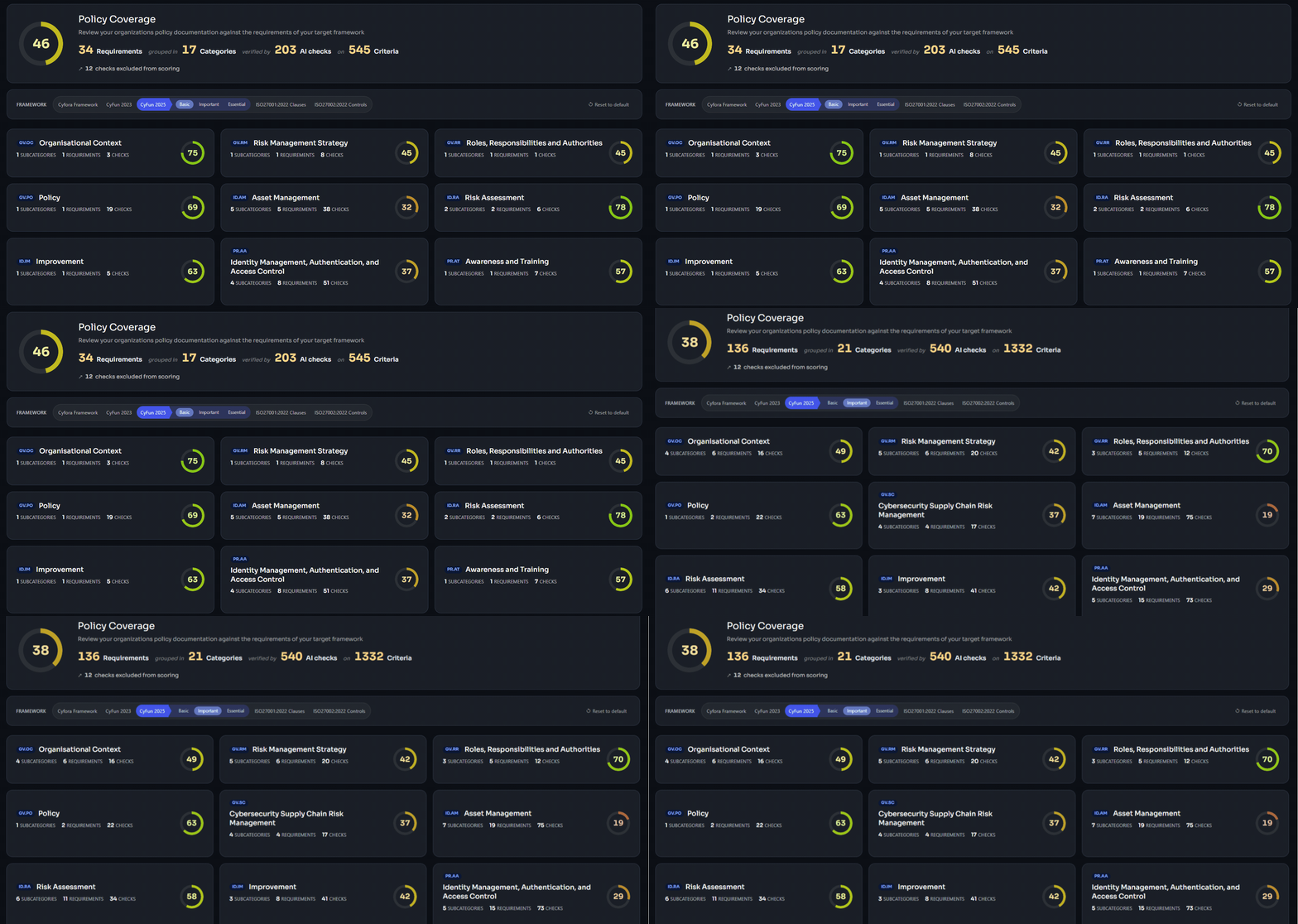
Fig 1: example from Cyfora platform what is the impact when going from Basic to Important Cyfun.
The 12-month window: what happens between audits
CyFun verification is generally valid for 12 months. ISO surveillance audits are annual; recertification every three years. That's a long window for things to drift unnoticed and a long window for your threat surface to change around you.
The events that erode posture are rarely dramatic. They're the accumulation of ordinary operational decisions: a new SaaS tool added without a security review, an M&A integration that grafts a poorly configured environment onto yours, a cloud migration that moved workloads but not the controls that governed them.
Or more practical examples like discussed in previous article: “You passed NIS2 / ISO 27001. Now what?”
None of these events trigger an audit. None of them show up in a status report. They just accumulate quietly until the next assessment surfaces them or until something worse does.
The NIS2-specific pressure
Under the Belgian NIS2 transposition, ex-ante supervision (NIS2 Inspection Service) for essential entities means the CCB can request evidence of compliance at any time, not just at a scheduled assessment. The CCB's April 2026 deadline for essential entities made this concrete: organisations needed to be able to demonstrate their posture on demand, not on a schedule of their choosing.
"We're preparing for next year's review" is not an answer to a regulator with ex-ante authority.
The board question nobody wants to answer
If a breach happened today and the board asked "were our controls in place?" how confident would your team be in the answer? Confident that the controls were in place at the last audit. Not confident that they're in place right now, as of this morning.
For most organisations, the honest answer is: we think so, but we don't know for certain.
From audit-ready to always-ready: what this actually means in practice
"Always audit-ready" sounds like permanent stress. It isn't. Done well, it's the opposite.
Episodic compliance means six weeks of frantic preparation every twelve months pulling evidence, chasing control owners, discovering gaps that have been quietly growing for most of the year. The people involved dread the run-up. The output is still a snapshot.
Continuous compliance means steady-state monitoring with no sprint, no fire drill, no late nights before the auditor arrives. Continuous compliance means your security posture is monitored all year, not just before an audit. When the auditor asks for evidence, you already have it — collected automatically, ready to share. The audit becomes a formality, not a fire drill.
The difference plays out across three layers:
Technical layer. Automated control validation against your actual security stack, not a spreadsheet approximation of it. Configurations are checked against secure baselines continuously. Drift is caught when it happens, not when it's discovered.
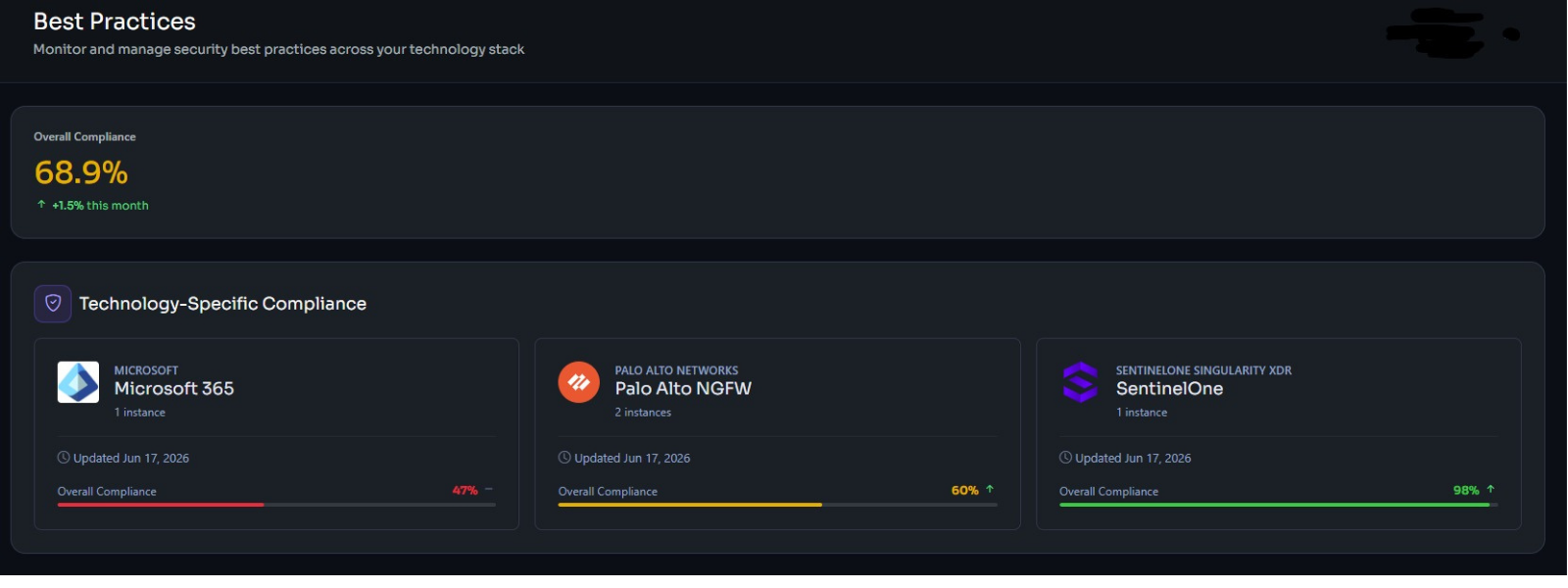
Fig 2: Example Continuous Best Practice monitoring in Cyfora platform
Policy layer. Policies validated against current framework requirements, not the version of the framework that was current when you first wrote them. As frameworks update, the gaps suface automatically rather than waiting for a human to notice.
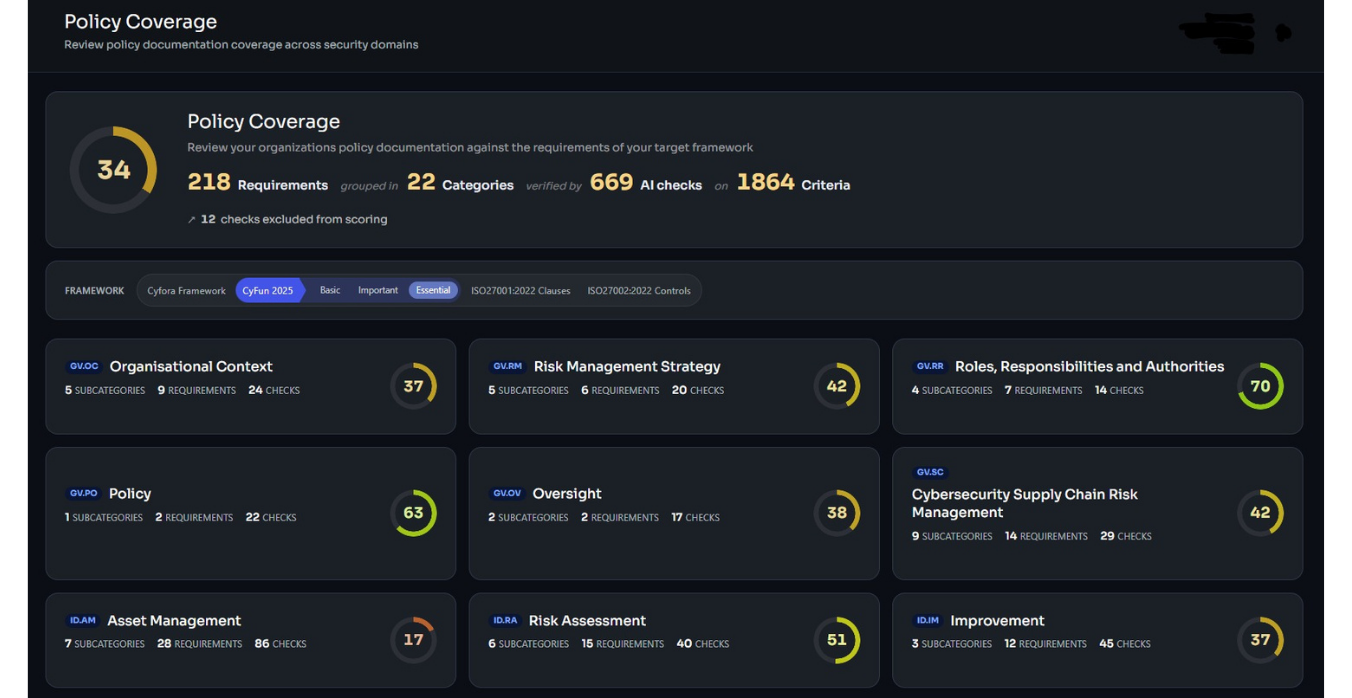
Fig 3: Example Continuous Policy Coverage monitoring in Cyfora platform
Evidence layer. Audit trail built passively as controls operate. Evidence collection isn't a separate,parallel activity that happens before assessments. It's a byproduct of the monitoring that's already running.
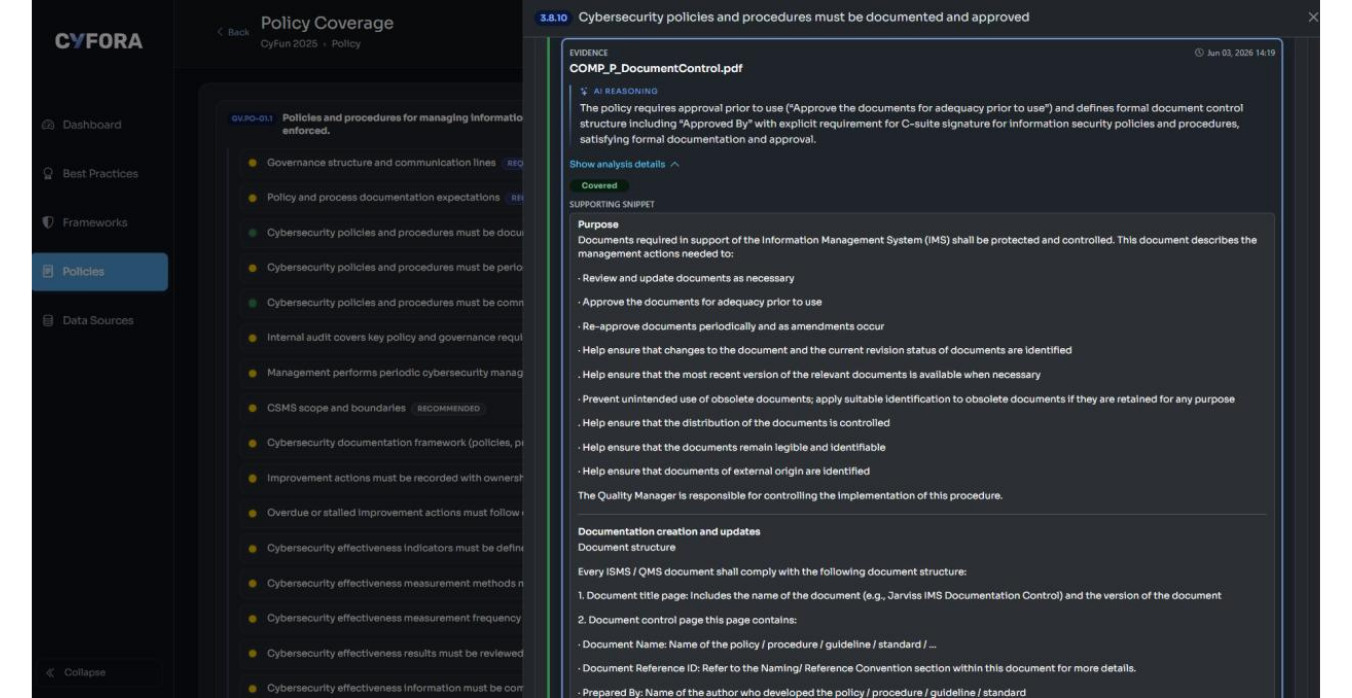
Fig 4: Example of a Evidence collection in Cyfora platform
The shift from episodic to continuous isn't just a process question. It's an accountability question. Who owns your posture on a Thursday in March, not during audit prep, just on an ordinary day? Manual processes can schedule a review. They can't watch the gaps in between.
The first 90 days after certification: building a maintenance rhythm
Days 1–30: capture the baseline while it's clean
The moment immediately after certification is the best possible time to document your configuration state. It's been reviewed, it has passed, and everyone who touched it is still available. This is your benchmark. Everything drifts from here.
Assign clear ownership to each control domain. Not "the security team" but a named individual. If a control has no named owner, it has no owner.
Days 30–60: instrument for visibility
Identify which controls are currently monitored automatically versus manually reviewed. This distinction matters more than any other. Manual reviews decay; automated monitoring doesn't forget, doesn't go on leave, and doesn't deprioritise a check because something else came up this week.
Set alert thresholds for configuration changes across your integrated tools. The goal is to know when drift happens, not discover it at the next audit.
Days 60–90: establish the review cadence
A monthly posture review doesn't need to be heavy. Sixty minutes, structured, focused on what has changed since last month and whether any of it matters. Not an audit, just a check-in.
A quarterly policy review: a lightweight pass to confirm that your policies still reflect both
operational reality and the current regulatory requirements. Most organisations skip this and discover the gap twelve months later.
An annual simulation: run a mock assessment before the real one. The point isn't to confirm what you already know. It's to find the surprises while you still have time to address them.
Making the case for ongoing investment — to a board that thinks you're done
Passing a NIS2 or ISO 27001 assessment sends a clear signal to your board: the security problem is solved. That reaction is understandable because certification is expensive, time-consuming, and visible. Of course the leadership sees it as a finish line.
The problem is that "we're certified" is exactly the kind of reassuring message that makes it harder to ask for budget the following quarter. If the audit is done, why does security still need investment?
Getting the board to invest in post-certification maintenance requires a reframe: certification was the cost of entry. Maintenance is the cost of staying safe and staying compliant.
The language that works in that room isn't "controls" or "framework alignment." It's operational risk, legal exposure, and business continuity.
The liability angle
Under NIS2 Article 20, management bodies bear personal accountability for cybersecurity governance. Directors can be held personally liable for failures to implement adequate measures.
That's not an IT budget line it's a board-level risk. Frame it accordingly. The question isn't whether the organisation can afford continuous compliance tooling. It's whether individual directors can afford the alternative.
Use the delta, not the absolute
The most effective argument isn't "here's our current compliance score." It's "here's where we were when we passed, and here's what's changed since." A gap that has demonstrably grown since the audit creates a concrete, defensible argument for ongoing investment in a way that an abstract score never can.
Your posture depends on more than your own stack
NIS2 Article 21 makes supply chain security an explicit obligation. Your compliance posture now includes the posture of your critical suppliers and the CCB is explicit about what it expects: organisations should require at minimum CyFun Basic alignment from direct suppliers.
That requirement flows in both directions. You may be receiving it from your customers and sending it to your vendors simultaneously.
The practical gap is significant. Most organisations have a reasonable view of their own configuration state. Very few have a live, maintained view of their top ten suppliers' posture. Annual questionnaires completed once a year by an account manager aren't the same thing.
A proportionate approach is achievable without turning supplier risk into a full-time program. Tier your suppliers by criticality. Your cloud infrastructure provider and your managed SOC represent fundamentally different risk levels than the SaaS tool your HR team uses for booking meeting rooms.
The teams that treat certification as a finish line will be running another audit sprint in eleven months. The teams that treat it as a baseline won't.
That's the compounding return of continuity. Continuous compliance gets cheaper over time. The evidence is already collected, gaps stay small because they're caught early, and audits become a confirmation of what you already know rather than a discovery exercise.
Before you archive the audit folder, three things:
Schedule the first monthly posture review. Put it in the calendar now, before the urgency fades.
Assign named ownership to every control domain. Not teams, but people.
Document the configuration baseline. This is your benchmark. Everything is measured from here.
The goal isn't to never have a finding. It's to never be surprised by one.
CYFORA helps organisations maintain continuous compliance between audits — with live configuration monitoring, mapped directly against NIS2 (CyFun 2023/2025), ISO 27001, and CIS v8.
Book a 30-minute walkthrough →
Author: Wim De Smet
